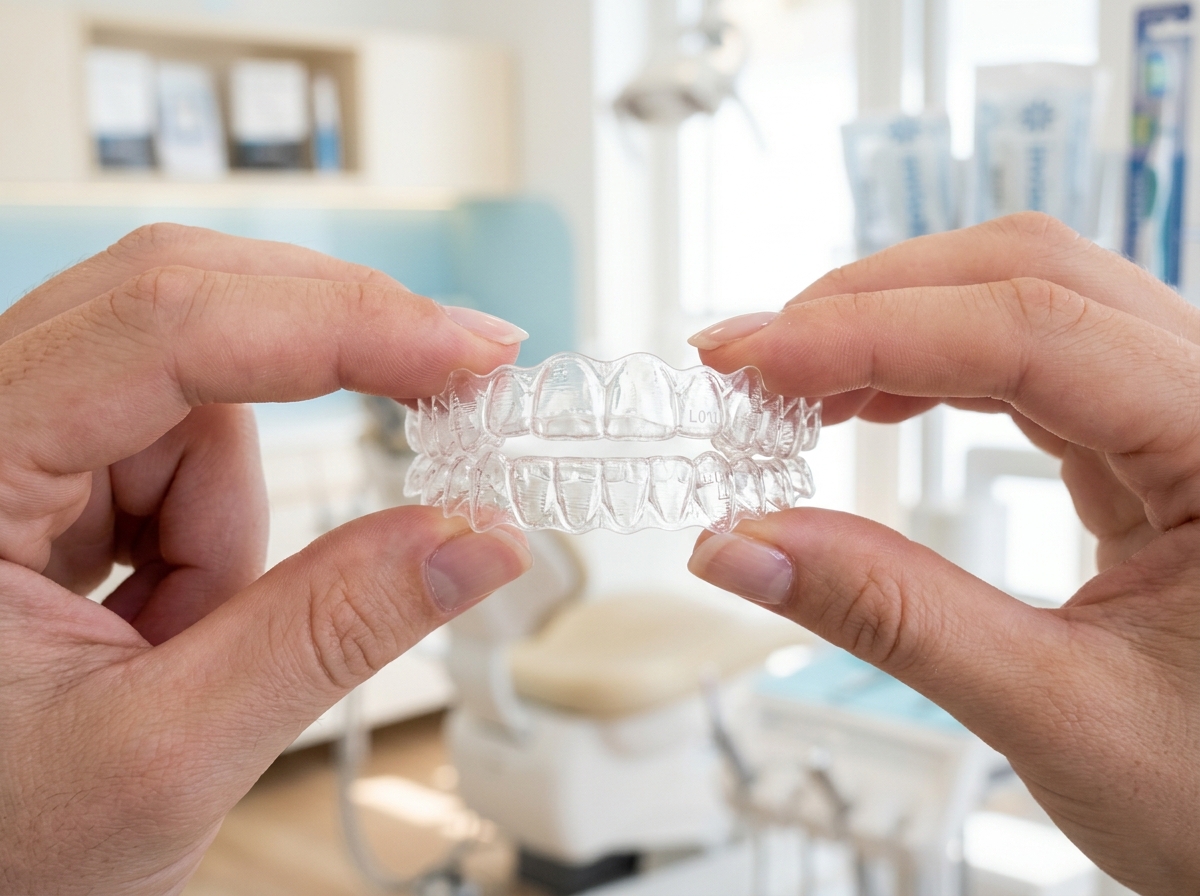
Clear Aligners
Clear aligners are a set of custom-fabricated, transparent plastic trays — each tray is worn for 1–2 weeks and moves your teeth a fraction of a millimetre closer to the target position. A full course of treatment involves anywhere from 10 to 60+ trays depending on complexity. Unlike braces, aligners are removable — you take them out to eat and clean your teeth, then put them back. The trays are nearly invisible in day-to-day wear.
Quick Clinical Answer
Clear aligners are a series of custom-made, removable, transparent plastic trays that gradually shift your teeth into the correct position. They are an alternative to traditional metal braces for mild to moderate orthodontic cases. They work only if worn for 20–22 hours a day — compliance is the single biggest factor in outcome.
- ✓Must be worn 20–22 hours a day — removing them defeats the treatment
- ✓Cost in India: ₹40,000–₹1,50,000 depending on brand and case complexity
- ✓Not suitable for all cases — severe crowding, large gaps, or bite issues need braces
- ✓Indian brands (toothsi, makeO) cost significantly less than Invisalign
- ✓Retainers after treatment are permanent — teeth relapse without them
Clear Aligners Procedure: Step by Step
What actually happens during the procedure — from initial diagnostic scans to final placement.
Clinical assessment and case suitability
The orthodontist examines your teeth, jaw, and bite to determine whether aligners are appropriate for your case. X-rays and photographs are taken. This is the most important step — and the one most often skipped by direct-to-consumer aligner brands who rely on at-home impressions without clinical oversight.
Digital scan or impressions
A 3D digital scan of your teeth is taken with an intraoral scanner (preferred) or traditional putty impressions are made. This data is used to fabricate the aligner trays. The scan is also used to create a digital simulation (ClinCheck for Invisalign, or similar) showing your projected tooth movement tray by tray.
Treatment plan review
Your orthodontist reviews the digital simulation and makes modifications to the automated tooth movement plan. This step is where clinical expertise matters most — the software-generated plan often needs adjustment for biological limits of tooth movement, anchorage, and bite coordination.
Attachment bonding and IPR
At the start of active treatment, composite attachments are bonded to specified teeth. Any required IPR is performed at this stage or progressively as treatment advances. Local anaesthesia is not needed for either procedure.
Active tray wear
You change trays every 1–2 weeks (as prescribed). Each tray must be worn 20–22 hours a day — removed only for eating, drinking anything other than water, and tooth brushing. Monitoring appointments are every 6–10 weeks to check progress and identify any teeth not tracking correctly.
Refinements
Once the initial set of trays is complete, your orthodontist assesses the result against the original plan. Almost all moderate and complex cases require additional refinement trays to complete tooth movements that didn't fully express. A new scan is taken and additional trays are fabricated.
Retainer fitting
Once treatment is complete and the result is confirmed, permanent retainers and/or removable clear retainers are fitted. This is the final and most critically underemphasised step in aligner treatment. Without retainers, teeth relapse. Most patients need to wear removable retainers every night indefinitely.
How Much Do Clear Aligners Cost in India?
Transparent benchmarks across accredited clinics in India. Avoid being overcharged for hidden laboratory or consultation markups.
| Category / Type | Procedure Cost (INR) | Materials / Crown | Estimated Total (INR) |
|---|---|---|---|
| toothsi / makeO (Indian brands) | ₹40,000–₹60,000 | Varies — remote monitoring common | Mild-moderate cases |
| Invisalign Lite (≤14 trays) | ₹60,000–₹80,000 | In-clinic orthodontist | Simple cases only |
| Invisalign Comprehensive | ₹90,000–₹1,50,000 | In-clinic orthodontist | Moderate to complex |
| Clinic-branded aligners | ₹45,000–₹85,000 | In-clinic dentist | Varies by case |
* Pricing in INR represents fair-market dental estimates. Costs vary based on clinical anatomy, specialist experience (BDS vs. MDS), and materials used.
Verified Orthodontists for Clear Aligners
1 SpecialistConnect with vetted dental specialists in Bengaluru. View verified qualifications, clinic addresses, consultation fees, and patient ratings.
Dr. Priya Nair
Frequently Asked Questions about Clear Aligners
Evidence-based answers to key patient questions on safety, recovery, and alternatives.
Not sure if you need Clear Aligners?
Get a free, unbiased second opinion from a verified Orthodontist. We review your X-rays and symptom history before you visit a clinic.
Get Free Specialist Consultation →