Dental Crown
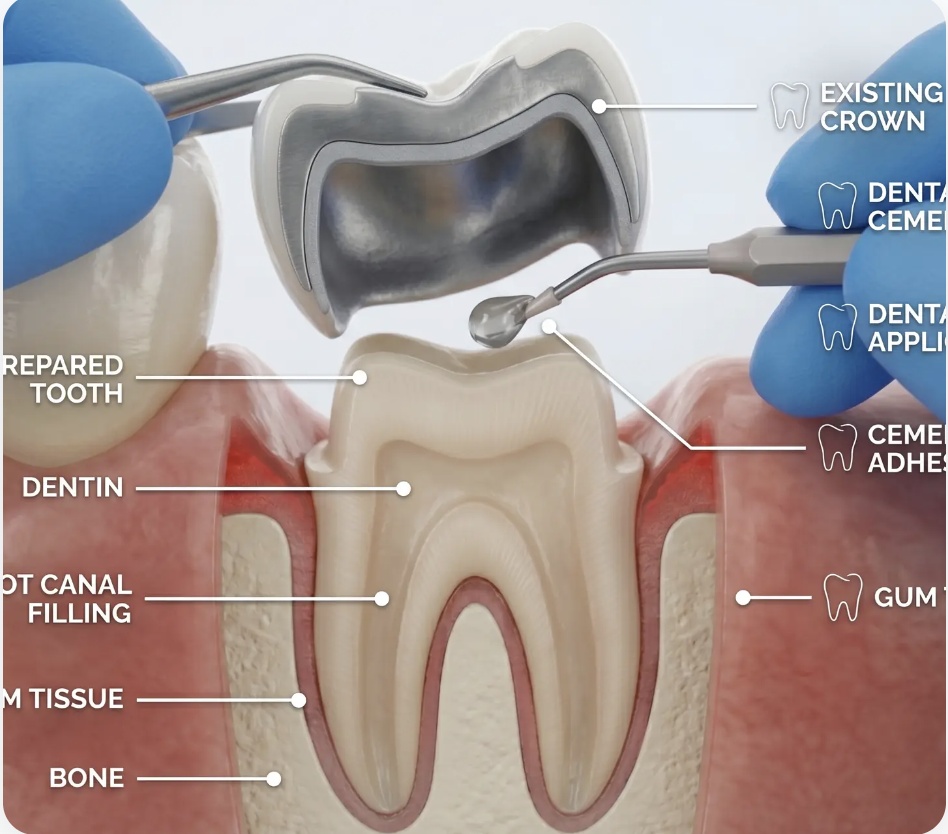
A dental crown (also called a cap) is a custom-made covering that fits over the entire visible part of a tooth — from the gum line up. The tooth is filed down to create space for the crown, impressions are taken, and a lab fabricates a permanent cap to match your bite and the shade of your surrounding teeth. Once cemented, it is fixed — not removable like a denture.
Quick Clinical Answer
A dental crown is a cap placed over a damaged or weakened tooth to restore its shape, strength, and appearance. It covers the entire visible portion of the tooth above the gum line. Crowns are genuinely necessary after root canals on back teeth, for severely cracked teeth, and for covering implants. They are frequently recommended unnecessarily for teeth that could be restored with a filling or inlay.
- ✓Covers the entire tooth above the gum line — permanent and cemented
- ✓Costs ₹3,000–₹15,000 depending on material (metal → zirconia)
- ✓Requires permanent removal of tooth structure — an irreversible step
- ✓Always necessary after root canal on a molar or premolar
- ✓Often recommended unnecessarily — second opinion is worth getting
Dental Crown Procedure: Step by Step
What actually happens during the procedure — from initial diagnostic scans to final placement.
Assessment and X-ray
The dentist examines the tooth and takes an X-ray to assess how much healthy tooth structure remains, whether the nerve is affected, and whether a crown is the most appropriate restoration. This step should determine whether a crown, an onlay, or a large filling would be the better clinical choice.
Tooth preparation
Under local anaesthesia, the tooth is filed down on all sides and the top to create a uniform 1.5–2mm space for the crown. The shape must be a specific taper to hold the crown securely. Preparation quality is the primary determinant of how well the crown fits and how long it lasts.
Impression or digital scan
Once the tooth is prepared, an impression is taken — either with putty material (traditional) or a digital intraoral scanner (modern, more accurate). This captures the exact shape of the prepared tooth and the surrounding bite. The impression is sent to the lab for crown fabrication.
Temporary crown
A temporary crown (usually acrylic) is placed on the prepared tooth while the lab fabricates the permanent crown. This protects the prepared tooth and maintains your bite and appearance. Temporaries are cemented with weak cement — avoid sticky or hard foods during this period.
Crown try-in and adjustment
When the permanent crown returns from the lab (1–2 weeks), it is placed on the tooth without cement first. The dentist checks the fit, the margin at the gum line, the bite in multiple positions, and the shade match. Adjustments are made before cementing. This step must not be rushed.
Permanent cementation
The crown is cemented with permanent dental cement and excess is carefully removed from around the margin — especially under the gum line. Any cement left behind becomes a harbour for bacteria, leading to gum disease and eventual crown failure. Final bite is checked and fine-tuned.
How Much Does Dental Crown Cost in India?
Transparent benchmarks across accredited clinics in India. Avoid being overcharged for hidden laboratory or consultation markups.
| Category / Type | Procedure Cost (INR) | Materials / Crown | Estimated Total (INR) |
|---|---|---|---|
| Metal (base alloy) | ₹1,500–₹2,500 | Hidden back molars only | 15–25 years |
| Porcelain-fused-to-metal (PFM) | ₹3,000–₹6,000 | Premolars, back teeth | 10–15 years |
| Full zirconia | ₹7,000–₹12,000 | Molars, premolars | 15–20+ years |
| Lithium disilicate (e.max) | ₹8,000–₹15,000 | Front teeth, premolars | 10–15 years |
* Pricing in INR represents fair-market dental estimates. Costs vary based on clinical anatomy, specialist experience (BDS vs. MDS), and materials used.
Verified Endodontists for Dental Crown
1 SpecialistConnect with vetted dental specialists in Bengaluru. View verified qualifications, clinic addresses, consultation fees, and patient ratings.
Dr. Rajesh Kumar
Frequently Asked Questions about Dental Crown
Evidence-based answers to key patient questions on safety, recovery, and alternatives.
Not sure if you need Dental Crown?
Get a free, unbiased second opinion from a verified Endodontist. We review your X-rays and symptom history before you visit a clinic.
Get Free Specialist Consultation →