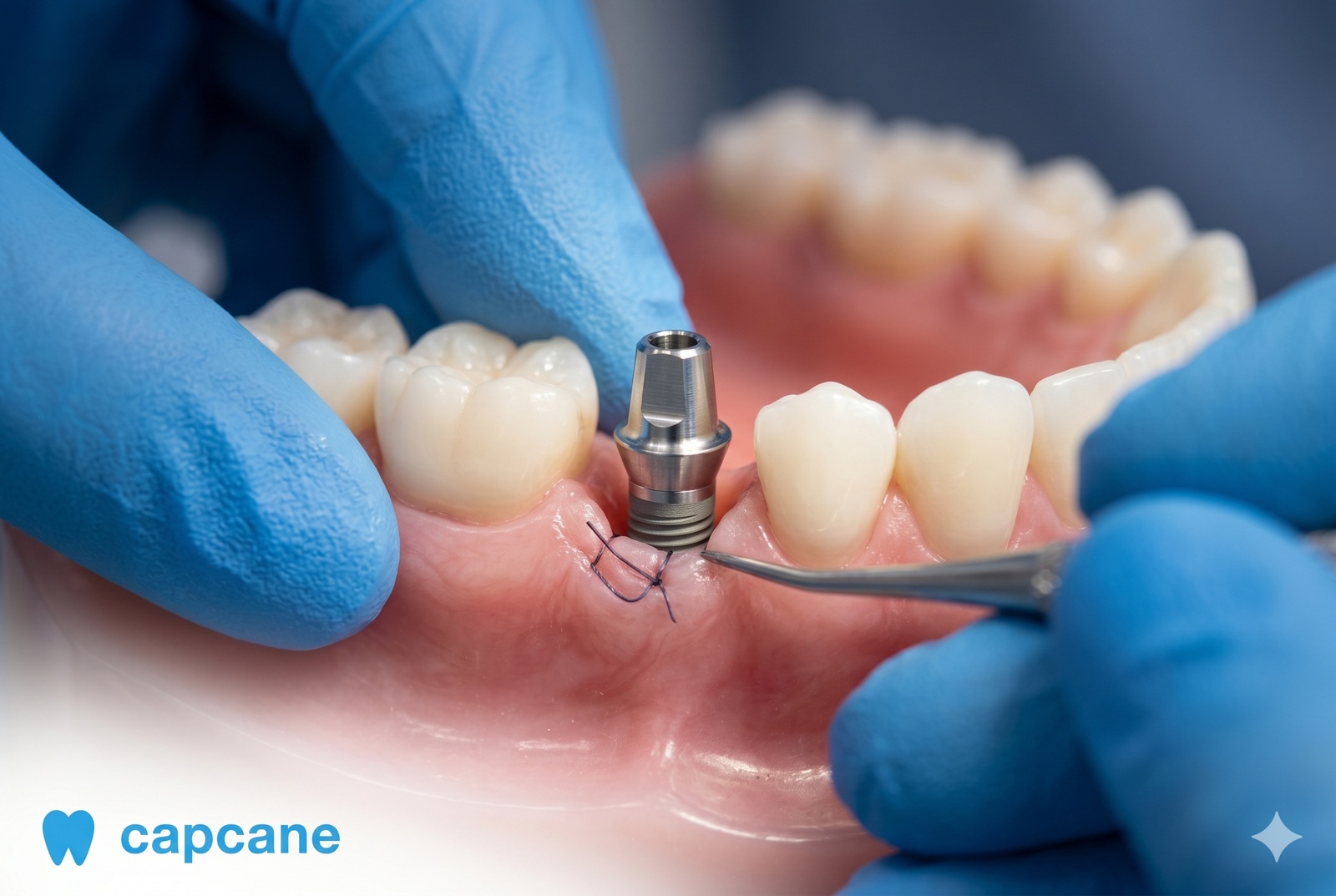
Dental Implants
A dental implant replaces the entire tooth — root and all. A small titanium screw is surgically placed into the jawbone where the missing tooth root used to be. Over 3–6 months the bone grows around and fuses to the titanium in a process called osseointegration. Once fused, a connector (abutment) and a custom crown are attached on top. The result looks, feels, and functions like a natural tooth.
Quick Clinical Answer
A dental implant is a titanium screw placed into the jawbone to act as an artificial tooth root. A crown is attached on top to replace the visible tooth. It is the closest permanent replacement for a natural tooth, with a 95%+ success rate over 10 years when placed correctly.
- ✓A titanium screw fuses to the jawbone over 3–6 months (osseointegration)
- ✓Total cost in India: ₹25,000–₹75,000 per tooth, all-in including crown
- ✓Korean implants (Osstem, Dentium) cost less; Swiss/US brands (Straumann, Nobel) cost more
- ✓Bone grafting may add ₹10,000–₹30,000 if jaw bone is insufficient
- ✓Not everyone is a candidate — uncontrolled diabetes and heavy smoking significantly reduce success rates
Dental Implants Procedure: Step by Step
What actually happens during the procedure — from initial diagnostic scans to final placement.
Assessment and imaging
A CBCT (3D cone beam) scan is taken to measure bone height, width, and density at the implant site. The proximity of the maxillary sinus (upper jaw) and inferior alveolar nerve (lower jaw) is mapped precisely. This scan determines whether you have enough bone, and at exactly what angle and depth the implant must be placed.
Bone grafting (if required)
If the scan shows insufficient bone, a bone graft is performed first — bone material (synthetic, animal-derived, or from your own jaw) is packed into the deficient area and covered with a membrane. The graft must heal for 3–6 months before the implant can be placed. Not all patients need this step.
Implant placement surgery
Under local anaesthesia, the gum is incised, the bone exposed, and a precisely sized pilot hole is drilled at the planned angle. The titanium fixture is screwed in. The gum is sutured over or around the implant. The surgery itself takes 30–60 minutes per implant. You will not feel pain during the procedure — only pressure.
Osseointegration (healing phase)
You go home. For the next 3–6 months, bone grows into the titanium surface and forms a solid biological bond. This cannot be rushed. During this period you may have a temporary denture or bridge for aesthetics. You must avoid smoking, hard foods on the implant side, and any infections in the mouth — all of which can cause the implant to fail during this phase.
Abutment placement
Once osseointegration is confirmed (usually by X-ray and stability testing), the gum is reopened and the abutment is screwed into the fixture. The gum tissue is shaped around it to form a natural emergence profile — this affects how the final crown looks at the gum line. Some implant systems place the abutment at the same time as the fixture.
Impressions and crown fabrication
An impression (or digital scan) of the abutment and surrounding teeth is taken. The lab fabricates a custom crown matched to the shape, size, and shade of your natural teeth. This takes 1–2 weeks.
Crown fitting and final bite adjustment
The crown is cemented or screw-retained onto the abutment. The bite is checked and adjusted in all directions — lateral, forward, and biting straight down. A crown that is even slightly high causes excess loading on the implant, which can lead to bone loss over time. This adjustment step must not be rushed.
How Much Do Dental Implants Cost in India?
Transparent benchmarks across accredited clinics in India. Avoid being overcharged for hidden laboratory or consultation markups.
| Category / Type | Procedure Cost (INR) | Materials / Crown | Estimated Total (INR) |
|---|---|---|---|
| Korean implant (Osstem, Dentium) | ₹15,000–₹25,000 | ₹8,000–₹15,000 | ₹25,000–₹40,000 |
| European / US implant (Straumann, Nobel) | ₹35,000–₹55,000 | ₹10,000–₹20,000 | ₹50,000–₹75,000 |
| All-on-4 (full arch, one jaw) | ₹1,80,000–₹3,50,000 | Included | ₹1,80,000–₹3,50,000 |
* Pricing in INR represents fair-market dental estimates. Costs vary based on clinical anatomy, specialist experience (BDS vs. MDS), and materials used.
Verified Oral & Maxillofacial Surgeons for Dental Implants
2 SpecialistsConnect with vetted dental specialists in Bengaluru. View verified qualifications, clinic addresses, consultation fees, and patient ratings.
Dr. K A Mohan
Dr. Swathi Kakathkar
Frequently Asked Questions about Dental Implants
Evidence-based answers to key patient questions on safety, recovery, and alternatives.
Not sure if you need Dental Implants?
Get a free, unbiased second opinion from a verified Oral & Maxillofacial Surgeon. We review your X-rays and symptom history before you visit a clinic.
Get Free Specialist Consultation →