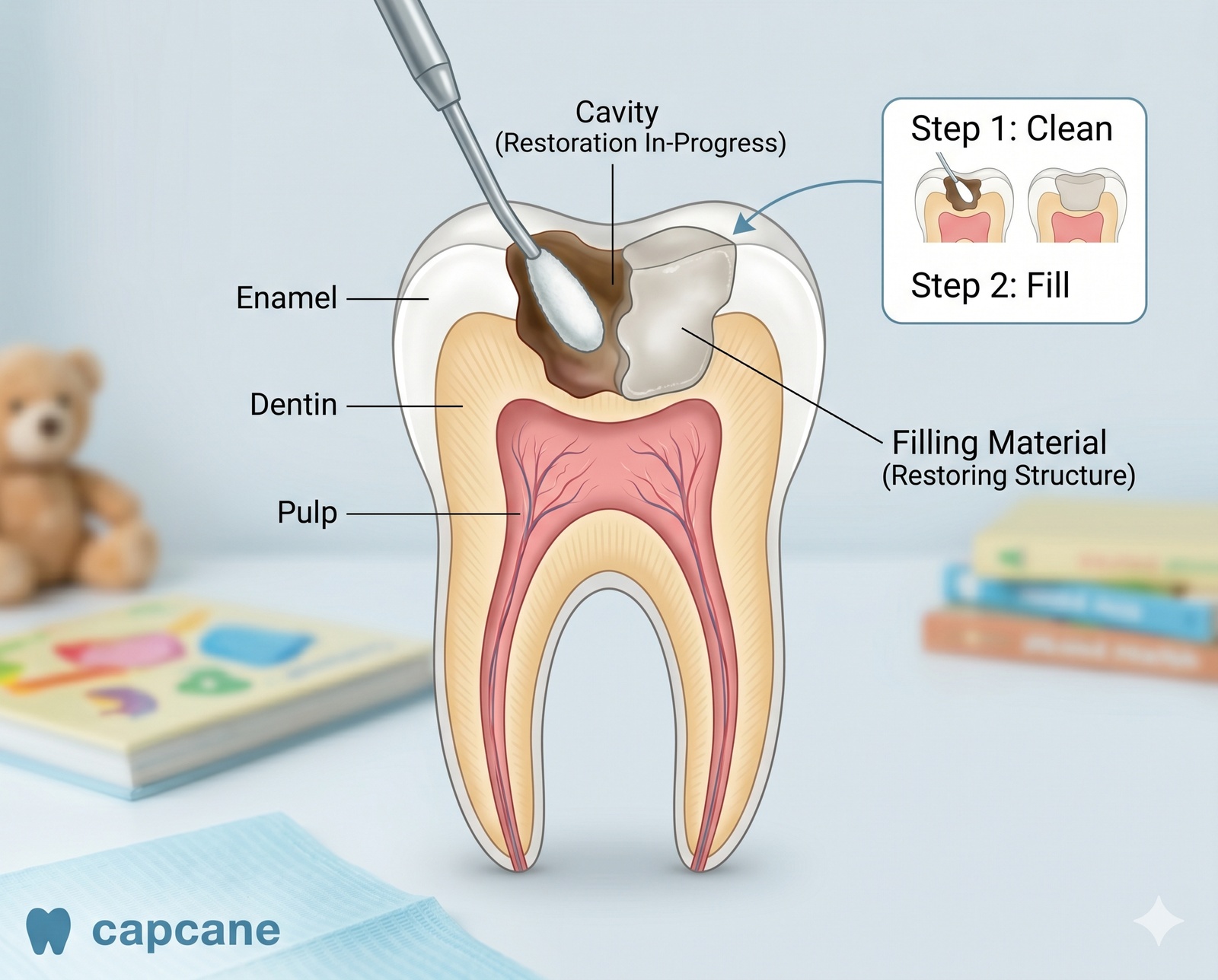
Pediatric Dental Fillings
Dental fillings for children work the same way as adult fillings — decayed tissue is removed and the cavity is restored with a material that seals and strengthens the tooth. The key difference in pediatric dentistry is the choice of material. Glass ionomer cement (GIC) is the first choice for most baby teeth because it releases fluoride, bonds without a dry field (easier in young children), and resorbs naturally as the tooth exfoliates. Composite resin is preferred for front teeth for aesthetics and is used in older cooperative children. The goal is always to stop the decay, protect the nerve, and buy time until the permanent tooth erupts.
Quick Clinical Answer
A pediatric filling removes decayed tooth tissue and seals the cavity with a restorative material. For baby teeth, glass ionomer cement (GIC) is the first-line choice — it bonds without a completely dry field, releases fluoride continuously, and resorbs naturally as the tooth exfoliates. Composite resin is preferred for front teeth and in older, cooperative children. In cases where a child cannot cooperate with drilling, silver diamine fluoride (SDF) can arrest decay chemically without any excavation. The right material depends on the child's age, anxiety level, cavity depth, and tooth type.
- ✓GIC is the material of choice for most baby teeth — bonds easily, releases fluoride, no dry field required
- ✓Composite resin offers better aesthetics but requires a completely dry operating field
- ✓SDF arrests decay without drilling — black staining is a significant trade-off
- ✓Cost in India: ₹700–₹2,500 per tooth depending on material and cavity size
- ✓Atraumatic Restorative Treatment (ART) — no drill, hand excavation + GIC — is a validated option for anxious children
Pediatric Dental Fillings Procedure: Step by Step
What actually happens during the procedure — from initial diagnostic scans to final placement.
Diagnosis & X-ray
Bitewing X-rays reveal interproximal (between-teeth) cavities that are invisible to the naked eye and allow assessment of decay depth. The dentist examines whether decay has reached the pulp or remains confined to enamel and dentin. This determines whether a filling is sufficient or whether pulp therapy (pulpotomy or pulpectomy) is required before restoration. Without an X-ray, dentinal caries between teeth will routinely be missed.
Behaviour Management
The dentist uses Tell-Show-Do (explaining each instrument before using it), positive reinforcement, distraction techniques, and a calm, child-friendly environment to help the child cooperate. For anxious or very young children, nitrous oxide (laughing gas) inhalation sedation is highly effective and safe. In rare cases of extreme anxiety or for very young children (under 3) requiring multiple fillings, conscious sedation or general anaesthesia may be considered. Anxiety management is as important as the technical procedure — a poorly managed anxious child will have dental anxiety for life.
Anaesthesia (If Needed)
For deep cavities close to the pulp, local anaesthesia is administered — topical anaesthetic gel first to minimise needle sensation, followed by infiltration or block injection. Shallow enamel-only or small dentinal cavities may be treated without anaesthesia, especially using ART technique with hand excavation. The dentist judges this based on cavity depth on the X-ray and the child's sensitivity during initial examination.
Decay Removal & Cavity Preparation
Decayed tissue is removed with a slow-speed round bur or hand excavator (for ART). All infected dentin must be removed, but healthy dentin can be preserved. The cavity shape is prepared to retain the filling material — undercuts for GIC, etched surfaces for composite. For GIC: a dentin conditioner (weak polyacrylic acid) is applied for 10–20 seconds to clean the cavity walls and enhance adhesion before rinsing.
Filling Placement & Finishing
For GIC: the cement is hand-mixed or dispensed from a capsule, packed into the cavity, shaped while still plastic, and excess removed. The surface is immediately coated with a protective varnish or bonding agent to prevent moisture contamination during the critical initial setting phase. For composite: acid etch is applied for 15–30 seconds, rinsed, dried, bonding agent applied and light-cured, then composite layered incrementally and each layer light-cured. Bite is checked with articulating paper and adjusted by removing high spots with a finishing bur.
How Much Do Pediatric Dental Fillings Cost in India?
Transparent benchmarks across accredited clinics in India. Avoid being overcharged for hidden laboratory or consultation markups.
| Category / Type | Procedure Cost (INR) | Materials / Crown | Estimated Total (INR) |
|---|---|---|---|
| Glass Ionomer (GIC) | Baby molars, anxious/young children | Yes — continuous | ₹700–₹1,200 |
| Composite Resin | Front teeth, older cooperative children | No | ₹1,200–₹2,500 |
| Compomer | Small-medium primary molar cavities | Yes — some release | ₹1,000–₹1,800 |
| Silver Diamine Fluoride (SDF) | Very young/uncooperative children, arrest-only | Yes — strong arrest | ₹500–₹900 per session |
* Pricing in INR represents fair-market dental estimates. Costs vary based on clinical anatomy, specialist experience (BDS vs. MDS), and materials used.
Verified Pediatric Dentists for Pediatric Dental Fillings
1 SpecialistConnect with vetted dental specialists in Bengaluru. View verified qualifications, clinic addresses, consultation fees, and patient ratings.
Dr. Ananya Sharma
Frequently Asked Questions about Pediatric Dental Fillings
Evidence-based answers to key patient questions on safety, recovery, and alternatives.
Not sure if you need Pediatric Dental Fillings?
Get a free, unbiased second opinion from a verified Pediatric Dentist. We review your X-rays and symptom history before you visit a clinic.
Get Free Specialist Consultation →