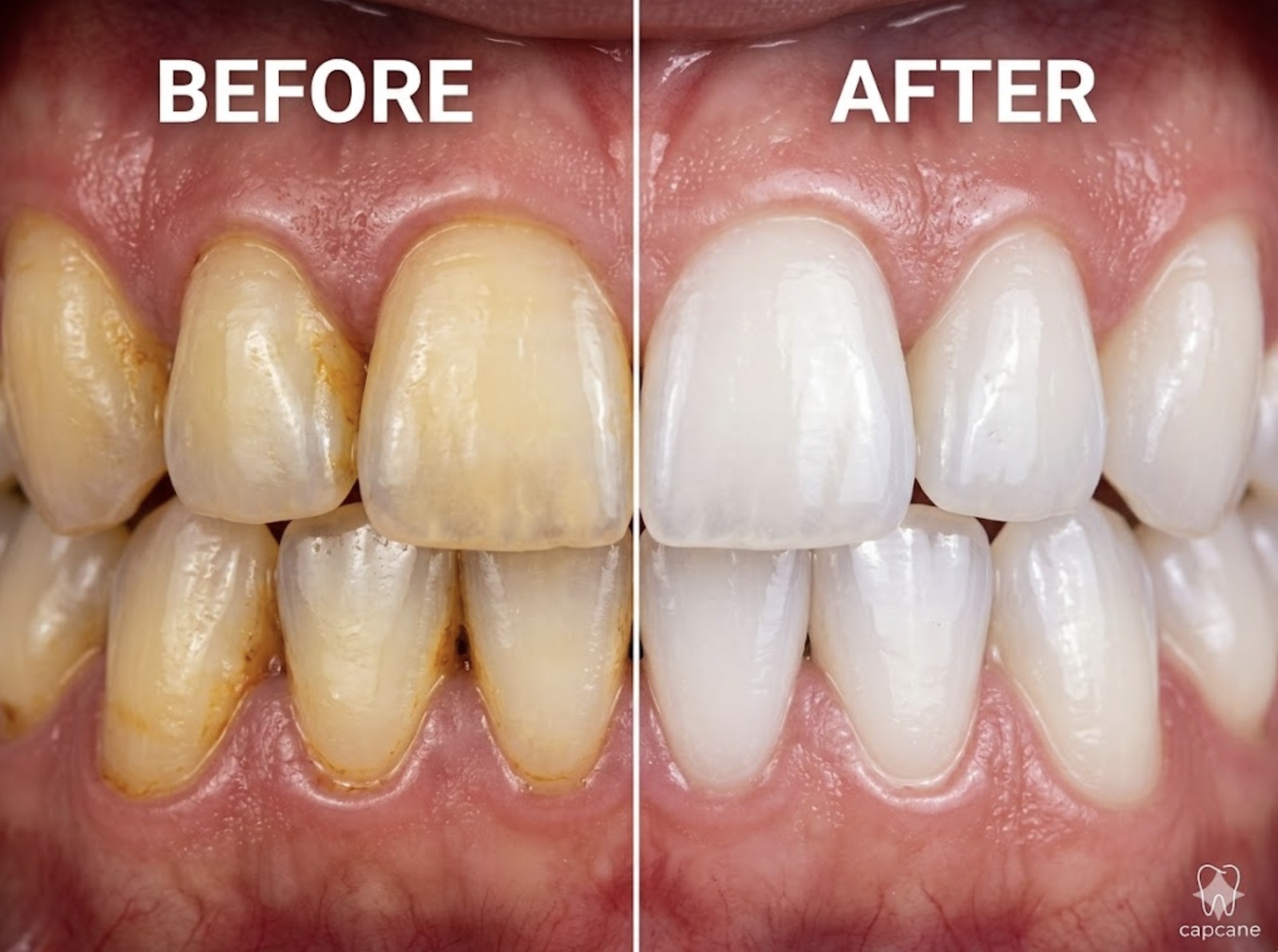
Teeth Whitening
Teeth whitening uses hydrogen peroxide or carbamide peroxide — bleaching agents that penetrate the enamel and break apart the chemical compounds responsible for tooth discolouration. The oxygen released during this chemical reaction lightens the colour of the underlying dentine (the layer that determines your tooth's base colour) and removes embedded stains from the enamel. The process does not damage enamel when used correctly, though temporary sensitivity is common.
Quick Clinical Answer
Teeth whitening uses peroxide-based agents to lighten the colour of natural tooth enamel. Professional in-clinic whitening produces the most significant results in a single session (1–1.5 hours). At-home whitening with custom trays from your dentist is slower but more economical. Whitening does not work on crowns, veneers, or bonding — these will stay their original colour while natural teeth lighten around them.
- ✓Only works on natural teeth — not crowns, veneers, or composite fillings
- ✓Results are not permanent — typically last 6 months to 2 years depending on diet
- ✓In-clinic cost: ₹5,000–₹20,000. At-home trays from dentist: ₹3,000–₹8,000
- ✓Surface stains from tea, coffee, and tobacco respond well. Intrinsic stains (from tetracycline or fluorosis) respond poorly
- ✓Sensitivity during and after whitening is very common and temporary
Teeth Whitening Procedure: Step by Step
What actually happens during the procedure — from initial diagnostic scans to final placement.
Pre-whitening assessment
Before any whitening, a dentist should examine your teeth and gums. Active gum disease, untreated cavities, or exposed root surfaces must be treated before whitening — the bleaching agent will cause severe sensitivity or damage if it reaches unprotected dentine through cavities or receded gums. A shade guide assessment documents your baseline tooth colour.
Professional scaling and polishing (if needed)
Surface tartar and stains are removed with scaling and polishing before whitening. Whitening gel cannot penetrate through tartar — and the tartar itself is discoloured. Removing it first maximises whitening results and may reduce the number of whitening sessions needed.
In-clinic whitening (option A)
Gum tissue is protected with a rubber dam or light-cured resin. High-concentration hydrogen peroxide gel (25–40%) is applied to all teeth. A UV or LED light may be used to activate the gel — though evidence on whether the light significantly enhances results versus gel alone is mixed. The gel is applied for 15–20 minutes, removed, and reapplied 2–3 times in one session. Total chair time: 60–90 minutes.
At-home dentist trays (option B)
The dentist takes impressions or a scan of your teeth and fabricates custom-fitted whitening trays. You are given a lower-concentration peroxide gel (10–22% carbamide peroxide) to use at home. Trays are worn for 1–4 hours daily, or overnight for the gentler concentrations, for 2–4 weeks. This method achieves comparable results to in-clinic whitening with lower sensitivity.
Sensitivity management
Sensitivity during and after whitening is very common. The peroxide temporarily dehydrates enamel and increases nerve sensitivity. Using a sensitivity toothpaste (containing potassium nitrate or fluoride) for 2 weeks before and after whitening significantly reduces this. Sensitivity resolves within 24–72 hours of completing treatment.
Maintenance and longevity
Results last 6 months to 2 years depending on your diet and habits. Coffee, tea, red wine, and tobacco are the primary causes of re-staining. A touch-up session with at-home trays (1–2 weeks of use) typically restores results. In-clinic whitening can be repeated, but not more frequently than every 6–12 months.
How Much Does Teeth Whitening Cost in India?
Transparent benchmarks across accredited clinics in India. Avoid being overcharged for hidden laboratory or consultation markups.
| Category / Type | Procedure Cost (INR) | Materials / Crown | Estimated Total (INR) |
|---|---|---|---|
| In-clinic (LED/power whitening) | ₹8,000–₹20,000 | 1 session | Immediately visible |
| At-home dentist trays | ₹3,000–₹8,000 | 2–4 weeks | Comparable to in-clinic |
| OTC whitening strips (Colgate etc) | ₹800–₹2,500 | 4–8 weeks | Mild improvement only |
| OTC whitening toothpaste | ₹200–₹600 | Ongoing use | Surface stains only |
* Pricing in INR represents fair-market dental estimates. Costs vary based on clinical anatomy, specialist experience (BDS vs. MDS), and materials used.
Verified Endodontists for Teeth Whitening
1 SpecialistConnect with vetted dental specialists in Bengaluru. View verified qualifications, clinic addresses, consultation fees, and patient ratings.
Dr. Rajesh Kumar
Frequently Asked Questions about Teeth Whitening
Evidence-based answers to key patient questions on safety, recovery, and alternatives.
Not sure if you need Teeth Whitening?
Get a free, unbiased second opinion from a verified Endodontist. We review your X-rays and symptom history before you visit a clinic.
Get Free Specialist Consultation →